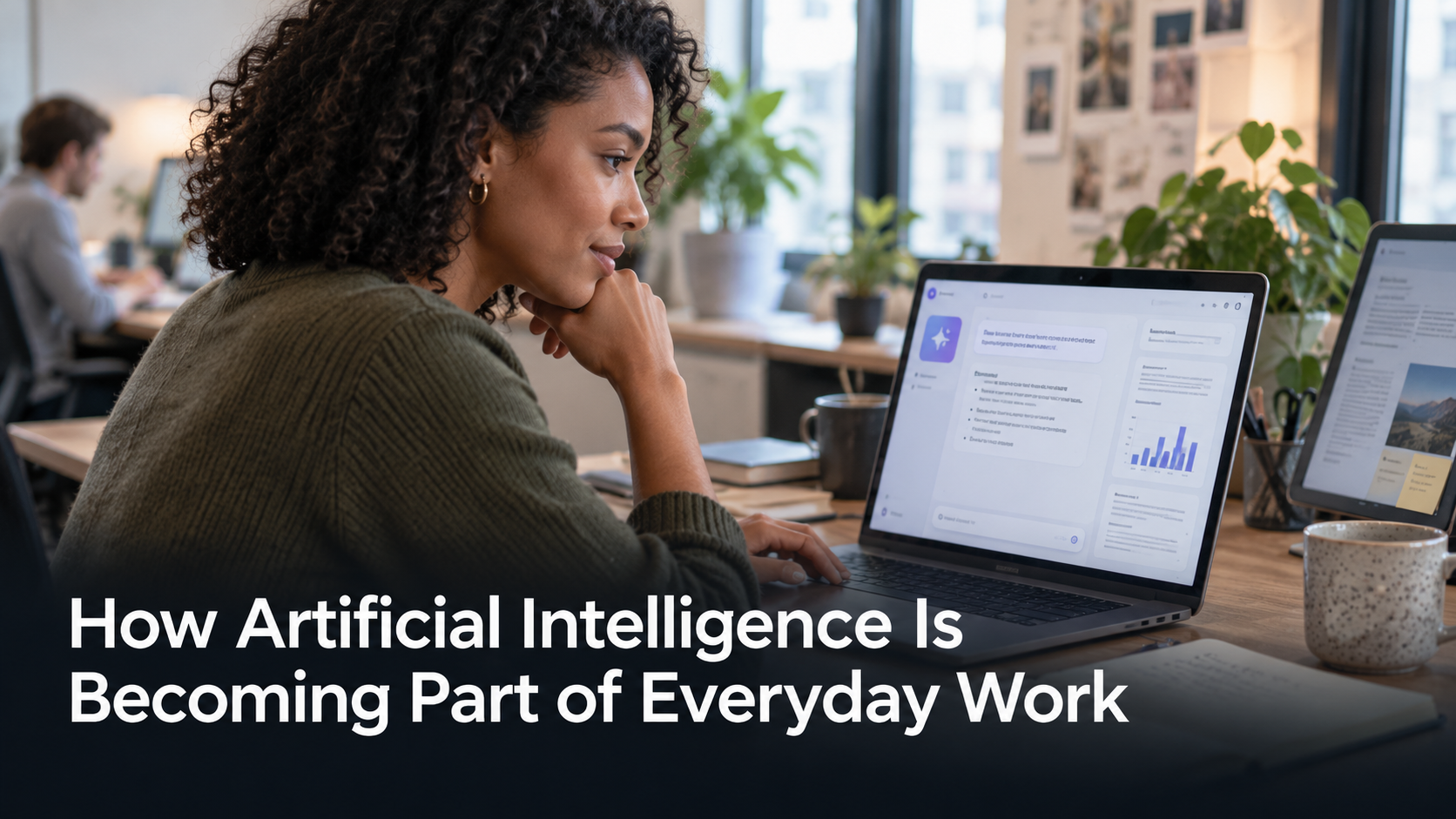
Artificial intelligence has moved quickly from a specialist technology into a tool used by professionals across many different industries.
Writers use AI to organise research. Developers use it to review code. Businesses use it to analyse information, answer customer questions and automate repetitive tasks.
However, the biggest shift may be happening quietly.
Rather than replacing entire jobs, AI is increasingly being used to assist with individual tasks inside existing roles.
AI as a Productivity Tool
Many professionals now use AI in much the same way they previously adopted spreadsheets, search engines or cloud software.
The technology can help speed up routine work.
Common examples include summarising documents, preparing first drafts, organising notes, generating ideas and analysing large sets of information.
This can reduce the time required for some tasks, but human review remains important.
AI systems can produce inaccurate information, misunderstand context or present uncertain information confidently.
For that reason, professionals increasingly need to understand both what AI can do and where its limitations remain.
Research Is One of the Biggest Use Cases
Research is an area where AI can significantly change workflows.
Instead of manually reviewing large amounts of information, users can often begin by asking an AI system to identify important themes or organise material.
This does not remove the need to verify information.
It changes the starting point.
A researcher might use AI to identify questions worth investigating, then confirm the important facts using original sources.
Used this way, AI becomes an assistant rather than the final authority.
Businesses Are Experimenting With Customer Support
Customer support is another area where AI adoption is growing.
Chat systems can answer common questions, guide users toward information and help businesses handle enquiries outside normal working hours.
However, automated support works best when customers can still reach a person for more complicated issues.
A poorly designed automated system can frustrate users if it repeatedly fails to understand their problem.
The strongest systems therefore combine automation with clear human escalation.
AI Is Changing Skills, Not Just Software
One of the most important effects of AI may be the way it changes valuable workplace skills.
Being able to ask good questions, verify information and communicate clearly becomes increasingly useful when working with AI systems.
Employees may also need stronger judgement because AI-generated output cannot always be accepted without review.
This means AI literacy is becoming relevant beyond technical professions.
Marketing teams, managers, analysts, educators and administrative staff may all benefit from understanding how these tools work.
Privacy and Security Remain Important
Businesses also need to think carefully about what information they provide to AI systems.
Confidential business data, customer information and private documents may require specific handling policies.
Organisations should understand the privacy terms of the tools they use and establish clear internal guidelines.
This becomes increasingly important as employees begin using AI independently.
The Future Is Likely to Be Gradual
Public discussion around artificial intelligence often focuses on dramatic future scenarios.
In reality, many of the most significant changes are happening gradually.
A worker saves twenty minutes preparing a report.
A small business answers customer questions faster.
A marketing team generates more campaign ideas.
A developer identifies an error earlier.
Individually, these changes may appear small. Across millions of workplaces, however, they can have a significant impact on productivity.
AI is likely to become less noticeable as it becomes more common.
Eventually, many people may simply consider it another standard workplace tool.

